Why Shaker Cabinets Stay in Demand
The Shaker door has outlasted beadboard, raised panels and high-gloss slabs because it solves a manufacturing problem and a decorating problem at once: a flat center panel is simple to finish and easy to live with. CasaBuilt lists 11 items in its Shaker collection against 2 in Frameless, and the cheapest six-cabinet Shaker kitchen on the site is $1,184.93. That is not nostalgia holding the style up. It is geometry.
Key takeaways
- The Shaker face carries no applied molding, so there is no ledge for grease and dust to sit on.
- 11 of the 28 cabinet items across CasaBuilt's four collections sit in the Shaker group.
- The basic six-cabinet kitchen ranges from $1,184.93 in Hudson Grey to $1,932.42 in Smokey Ash.
- The door is a rubberwood frame around an MDF panel, finished in seven coats with a UV topcoat.
A frame and a panel, with nothing stuck on top
The Shaker door is five pieces: two vertical stiles, two horizontal rails and a flat panel set behind them. Nothing is applied to the face. That single decision removes the two features that date a kitchen fastest, because a raised panel brings six edges that collect cooking grease and an applied molding brings a shape that has to agree with the trim in the next room.
A frame also scales. The same rail width reads correctly on a 9-inch spice pullout and on a 42-inch sink base, which is why a run of mismatched cabinet widths still looks like one kitchen rather than a collection of boxes. Kitchen designers call this rhythm. Buyers experience it as the room not looking busy.
There is a maintenance argument too. A flat panel wipes in one pass, and a painted finish on a flat surface shows fewer shadows than the same finish on a profiled edge. In a rental or a family kitchen, that difference shows up every Saturday morning.
The collection counts show where the offer sits
CasaBuilt publishes four style collections, and the item counts inside them are a fair proxy for where the company expects demand to land. Shaker holds 11 items, Framed holds 14, Frameless holds 2 and Raised Panel holds 1. Door profiles named across the catalog are Shaker, Double Shaker, Slim Shaker, Frameless, Raised Panel and High Gloss.
| Collection | Published items | Door character | Where buyers use it |
|---|---|---|---|
| Shaker | 11 | Five-piece door with a recessed flat panel | Whole kitchens, rentals, resale-ready remodels |
| Framed | 14 | Face-frame box carrying the broader style list | Buyers who want a trim line at the cabinet edges |
| Frameless | 2 | No face frame, doors meet the box edge | Compact rooms and slab-leaning layouts |
| Raised Panel | 1 | Profiled center panel that stands proud | Traditional rooms with matching millwork |
Add the four counts and the catalog holds 28 items. The Shaker group is 11 of those 28, or 39 percent, and the Framed group carries the largest single block because it wraps several door profiles into one face-frame construction. The distribution explains a pattern most buyers notice in showrooms without being able to name it: the flat door is not a niche choice sitting at the edge of the range. It is the middle of the range, with the styled doors arranged around it.
What the door is made of, and why that matters to the look
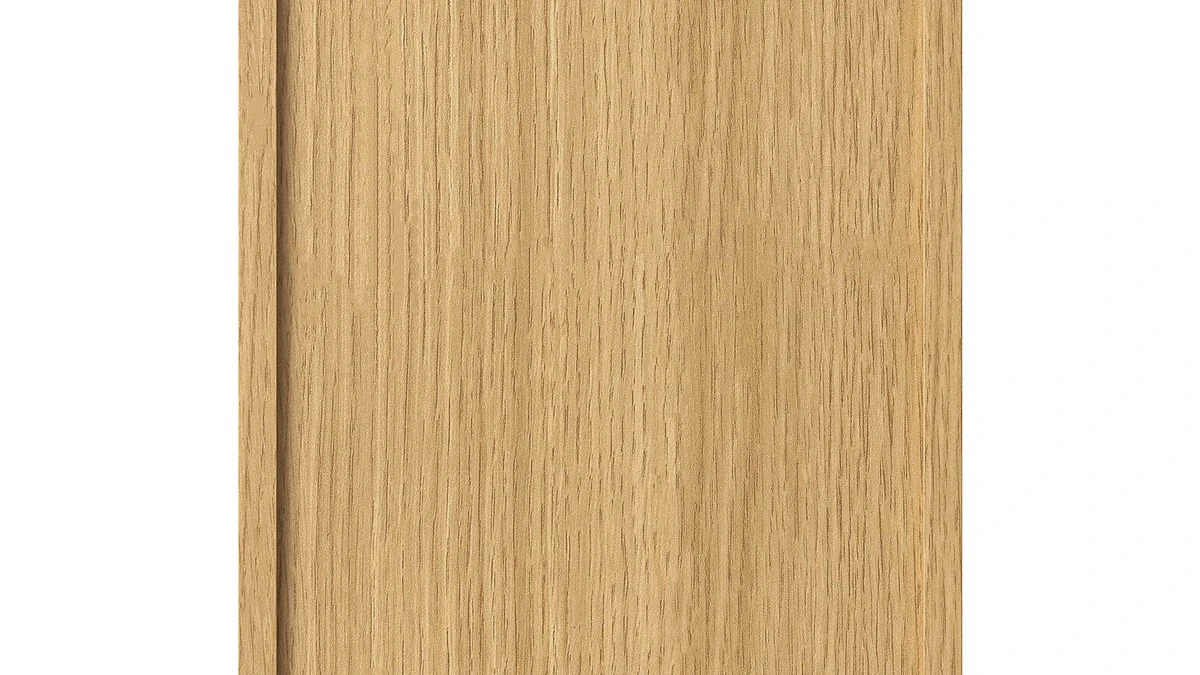
The published specification for the oak-look line is a useful stand-in for the whole family. The door is a rubberwood frame with an MDF panel, built as a full-overlay door with a slim shaker profile. The box is 1/2-inch birch plywood with a natural birch interior, and the face frame is 3/4-inch by 1-1/2-inch solid birch. Hinges are concealed, soft-close and adjustable on six axes, which is the detail that keeps a run of doors sitting level years after installation.
Finish is where a painted flat door earns or loses its keep. CasaBuilt specifies seven layers of paint with a UV protective finish. Seven passes cost more than two, and the UV layer is the reason a white door in a south-facing kitchen holds its color instead of drifting toward cream. The range the company groups under shaker cabinets leans almost entirely on painted finishes, so the coat count is not a marketing footnote; it is the product.
Buyers who want a box without the face frame have a narrower path. The frameless collection holds two items, and it changes the reveal at every cabinet joint, which changes how much of the door you actually see.
Why the plain door still carries a price ladder
A flat door looks like the cheapest thing in the catalog, and in one sense it is: the White Shaker six-cabinet kitchen is $1,199.50 against a struck-through $2,399.00. But the same geometry in a different finish moves the number a long way. Hudson Grey lands at $1,184.93, Navy Blue at $1,230.69 and Smokey Ash at $1,932.42. The slim profiles sit higher again, at $2,148.28 for Slim Aston Green and $2,295.64 for Slim White Oak.
The spread between the cheapest painted Shaker kitchen and the oak-look version is $1,096.14. None of that gap comes from the door shape, which is nearly identical in all six lines. It comes from the finish schedule and the narrower rail of the slim profiles, both of which consume more shop time per door. A buyer who wants the look without the outlay should price the painted lines first and treat the oak-look finish as an upgrade decision rather than a style decision.
Worked example: what the entry prices actually buy
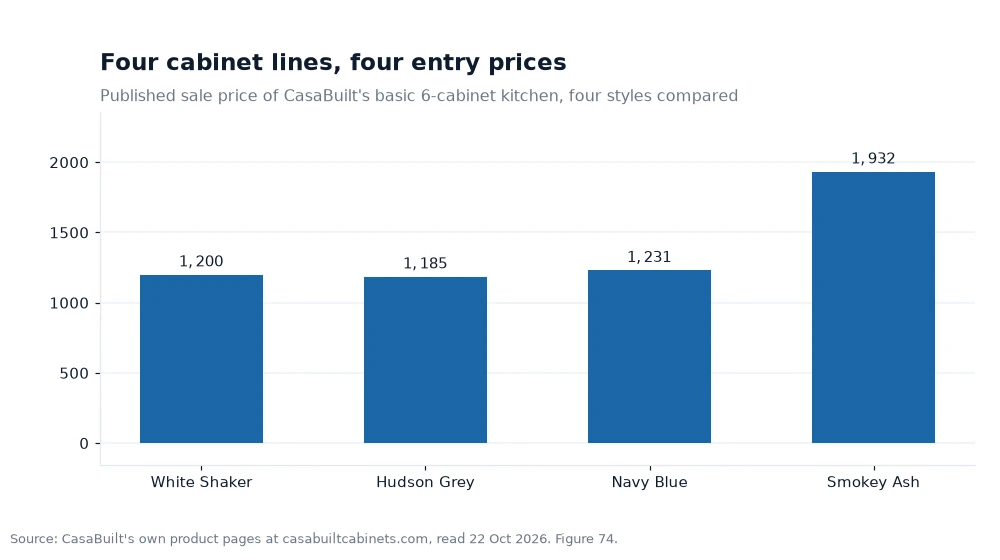
The chart compares four entry prices for the same six-cabinet bundle: two base cabinets, two wall cabinets, one tall cabinet and one vanity. White Shaker is $1,199.50, Hudson Grey is $1,184.93, Navy Blue is $1,230.69 and Smokey Ash is $1,932.42. Divide each by six to get a per-cabinet figure: $1,199.50 / 6 = $199.92, $1,184.93 / 6 = $197.49, $1,230.69 / 6 = $205.12 and $1,932.42 / 6 = $322.07.
The gap between the lowest and highest of the four is $1,932.42 minus $1,184.93, which is $747.49 for identical cabinet boxes. As a ratio, $1,932.42 / $1,184.93 = 1.63, so the Smokey Ash bundle costs 63 percent more than the Hudson Grey bundle. Divide the gap by the $9.99 sample price and $747.49 / $9.99 = 74.8, meaning the difference would buy 74 sample doors with about $8 left over. That is the size of the finish decision before a single drawer insert or crown molding is added.
Frequently asked questions
Do Shaker doors work in a modern kitchen?
Yes. The profile is a rectangle with a recessed panel, which is close to the visual language of modern cabinetry, and the slim shaker rail narrows the frame further for a more contemporary line. The style fails only when the rail is too wide for the room, which is a proportion problem rather than a period problem.
Is a flat panel harder to keep clean than a slab door?
It is slightly harder than a slab and considerably easier than a raised panel. The recess has four interior corners, so a cloth needs to reach into the frame line, but there is no applied molding and no ledge on the face. Seven coats of paint with a UV topcoat also give the surface a smooth, wipeable film.
Can I mix Shaker doors with a different profile in one kitchen?
You can, and the usual place is a tall cabinet or an island where a slab or glass door breaks up the repetition. Keep the box construction and the finish identical, because a change of sheen between two door styles shows more than a change of shape.
Next step before you commit to a door style
Order a sample in the finish you are actually considering, not the one that looks best on a monitor. Stand it against the wall at the height it will hang and look at it in the morning and again under the room lights, because paint with a UV topcoat shifts less than the screen does. Then price two lines on the same cabinet list and compare the totals, since the door shape is rarely the line item that moves the budget.
The style decision is the easy part. The expensive part is discovering a finish mismatch after 20 doors have been drilled and hung.
Figures quoted here come from the manufacturer's own website, read 22 Oct 2026[1].