Private Label Fragrance: Documents a Retailer Has to Hold
Documents are not an administrative afterthought of a private label fragrance project; they are the part that determines whether the product can legally be sold in the market you have chosen. The retailer, as the brand owner, usually carries responsibility for the finished product even when the factory holds the factory-side records. Understanding which document comes from whom, and when, is what keeps a launch from stalling at the border or at the printer.
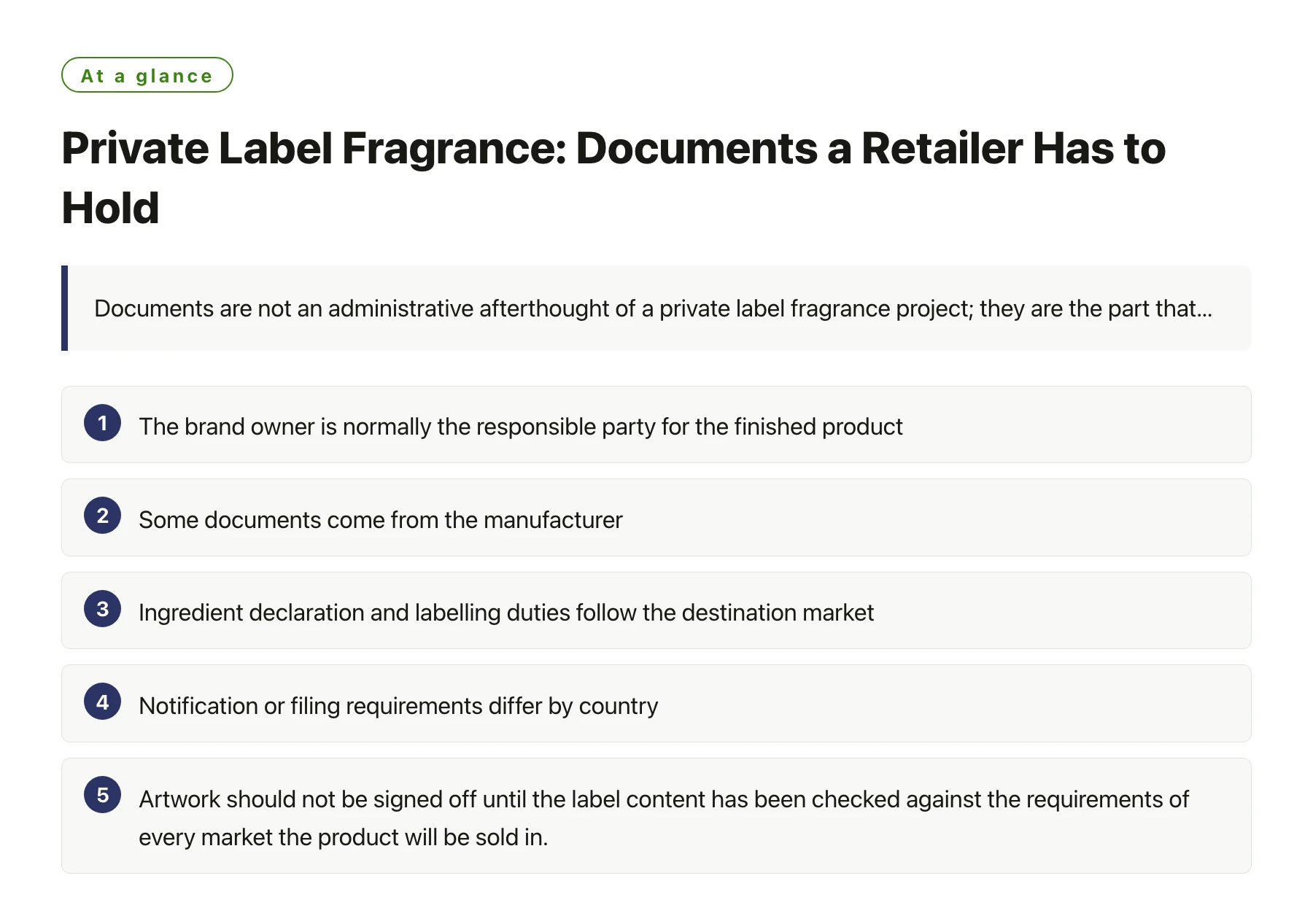
Key takeawaysThe brand owner is normally the responsible party for the finished product, so the retailer cannot delegate product-level obligations to a factory by contract alone [1]. · Some documents come from the manufacturer, such as batch records and certificates of analysis; others must be created or commissioned by the brand. · Ingredient declaration and labelling duties follow the destination market, and the naming of ingredients is standardised in references such as the EU CosIng database [2]. · Notification or filing requirements differ by country, and several markets require a local entity or representative to submit them [3]. · Artwork should not be signed off until the label content has been checked against the requirements of every market the product will be sold in.
A first own-brand range usually starts with a formula conversation and ends with a stack of documents nobody expected. The stack is manageable if it is planned early and confusing if it is assembled at the last minute, because each item has a different author and a different lead time.
The list below is written from the retailer's side. It separates what the factory can hand over from what the brand has to own, and it flags the items that most often delay a launch.
None of it is exotic, and none of it should be improvised. A retailer that treats the document list as part of the product specification will find the compliance work absorbs far less time than one that treats it as post-launch admin.
The document set, and who provides what
| Document | What it covers | Usually provided by |
|---|---|---|
| Product information file | The technical and safety record for the finished cosmetic product | The brand, often with a safety assessor [1] |
| Safety assessment report | The conclusion that the finished product is safe for its intended use | A qualified assessor, commissioned by the brand |
| Ingredient declaration | The ingredient list, named in the standard nomenclature for the market | Compiled from the formula, checked by the brand [2] |
| Allergen labelling check | Whether any fragrance component must be declared on the label | The brand, with formula data from the manufacturer |
| Fragrance compliance statement | Confirmation that the concentrate meets industry material restrictions | The fragrance house or the factory |
| Stability and microbiology reports | How the product and its packaging behave over time | The manufacturer or a third-party laboratory |
| Certificate of analysis | The measured result for a specific production batch | The manufacturer, per batch |
| Notification or filing | Registration of the product with the market authority | The brand or its local representative [3] |
| Manufacturing licence and GMP evidence | The factory's authorisation to produce cosmetics | The manufacturer |
The pattern is worth noting: the factory-side documents are procedural and repeatable, while the product-side documents are brand responsibilities. Projects go wrong when the second group is assumed to be included in the first. A supplier that describes its scope openly, including Xuelei OEM manufacturing, gives a buyer a concrete starting point for that conversation.
The three points where retailers get caught
The first is the assumption that compliance travels with the goods. A supplier can provide the concentrate documentation, the test reports and the batch record, and the product can still be unsellable in a market because the brand-side file was never assembled.
The second is artwork timing. The label carries claims, ingredients and warnings, and each of those can be market-specific. Signing off a print run before the label content has been checked is the single most expensive compliance mistake in own-brand programmes.
The third is market scope. A range designed for one country and later extended to another often needs a new label, a new filing and sometimes a different formulation, because restrictions and declaration duties differ.
Ask for the pack as a document set
Ask the factory to list, in writing, the documents that arrive with a first order and the documents that are available on request. Anything in the second group should be costed and scheduled, because requests made after production are the ones that delay shipments. A primer on safety testing in perfume manufacturing is useful here, because it separates the checks run on the concentrate from those run on the finished goods, and that distinction decides whose document each report becomes.
Keep documents with the batch, not with the project
Retailers tend to file documents by product name. It is more useful to file them by batch, because a certificate of analysis only means something for the batch it describes. When a customer query arrives two years later, the batch number is the only reliable key.
Decide who signs the label
Name the person accountable for the final artwork content. In most companies this sits with the brand owner, and it should be a named role rather than a shared assumption between marketing, sourcing and a supplier.
A useful habit before any print run: produce a one-page label content sheet that lists every claim, ingredient, allergen and warning on the pack alongside the market it applies to. If a line cannot be justified by a document, it comes off the artwork.
Where the factory can genuinely help
Manufacturers that export regularly keep a standard pack of documents ready, and they know which markets ask for what. That experience is worth using: ask what the last three customers in your target market had to submit, and how long each item took.
It is also reasonable to ask how testing is organised, since stability and microbiological work sits between sample approval and bulk release and not every supplier does it in the same way [4]. Ask which of those tests are run in house and which are sent to a laboratory, because that determines the lead time attached to the release step.
Some suppliers publish their certification list and service scope, which gives a buyer a concrete starting point for the document conversation. A page such as the scope described on the official Xuelei website can be checked line by line against the documents you actually need.
Write the document list into the purchase order
Attach the list of required documents to the order and make the final payment conditional on delivery. A document requested for the first time after the goods are packed is a favour; one written into the order is an obligation.
Test the label before the launch, not after
Check one filled and labelled unit against the market requirements before the whole run is printed or shipped. It is a cheap step, and it catches the errors that are most expensive to correct.
Sources
- European Commission: Cosmetics in the EU —— The European Commission's overview of EU cosmetics rules, including the responsible person, product information file and safety report requirements.
- EU CosIng — Cosmetic Ingredient Database (European Commission) —— The European Commission's CosIng database of cosmetic ingredients, listing ingredient functions, restrictions and labelling requirements under EU cosmetics law.
- Health Canada: Cosmetic Safety —— Health Canada's cosmetics pages, covering cosmetic notification, the ingredient hotlist and safety requirements for cosmetics sold in Canada.
- SGS: Cosmetics, Personal Care & Household Testing —— Testing, inspection and certification services for cosmetics and personal care, including microbiological, stability and safety testing aligned with cosmetics GMP.
Frequently asked questions
Who is legally responsible for the finished cosmetic product?
In most markets the party placing the product on the market, which for an own-brand range is the retailer or brand owner. The manufacturer's records support that responsibility but do not replace it.
Can the factory provide the product information file?
Some can support it, particularly if they hold cosmetic GMP and export regularly, but the responsibility usually stays with the brand. Confirm in writing what is supplied and what you must commission.
When should the label content be finalised?
Before any print run, and ideally before tooling is released. Ingredient, allergen and claims wording can change with the market, and reprints are far more expensive than a design revision.
Do I need different documents for each country?
Often, yes. Notification procedures, labelling duties and certain restrictions differ between markets, so the same product can need a different label and filing in each one.
How long should I keep batch documents?
Long enough to answer a customer query or a market inspection years after the sale. Filing by batch number rather than by product name makes that practical.