Choosing AC Output for Mixed Single-Phase and Three-Phase Vehicles
Choose an alternating-current (AC) charging configuration by checking the supply and the vehicle together. A three-phase chargepoint does not make every vehicle charge on three phases, and a higher headline power does not override the vehicle’s onboard charger. For a mixed car park, the useful buying document is a short vehicle-and-supply record, not a list arranged from the smallest kilowatt rating to the largest.
This matters when employees, visitors or replacement vehicles use different models. Two cars connected to identical equipment can receive different power without either chargepoint being faulty. Procurement needs to establish which differences are expected before promising a charging service.
Separate the three ratings
Start with the electricity available at the proposed location. Record the voltage and phase arrangement confirmed by the project’s electrical team. Do not infer the usable charging supply from a photograph of a distribution board or from another charger elsewhere on the property.
Next, record the quoted chargepoint’s output configuration. A product family can contain different versions, and a site setting may limit an installed unit below its maximum capability. The cable and connection arrangement must also suit the proposed duty.
Finally, find each vehicle’s AC charging specification. AC-to-battery conversion happens in the vehicle. Its onboard charger, supported phase arrangement and configured limits help determine what it can take from the equipment. Keep those vehicle facts separate from the chargepoint catalogue entry.
Make one useful record for each vehicle group
A practical record names the vehicle model and variant, its documented AC capability, the proposed supply arrangement and the expected charging limit. Add the source and date of the vehicle information. Leave an uncertain field visible rather than filling it with the best figure advertised for a different variant.
For an illustrative comparison, suppose one car accepts up to 11 kW AC and another accepts up to 7.4 kW through its supported arrangement. Connecting both to equipment advertised at 22 kW does not establish 22 kW charging for either vehicle. The exact result still depends on the supply, equipment configuration and cable. These assumed figures explain the comparison; they are not specifications for an EVB installation.
Record the expected limit in words as well as numbers: “vehicle-limited”, “site-configured limit” or “not yet established”. That distinction helps staff explain a normal difference later.
Compare configurations within the product range
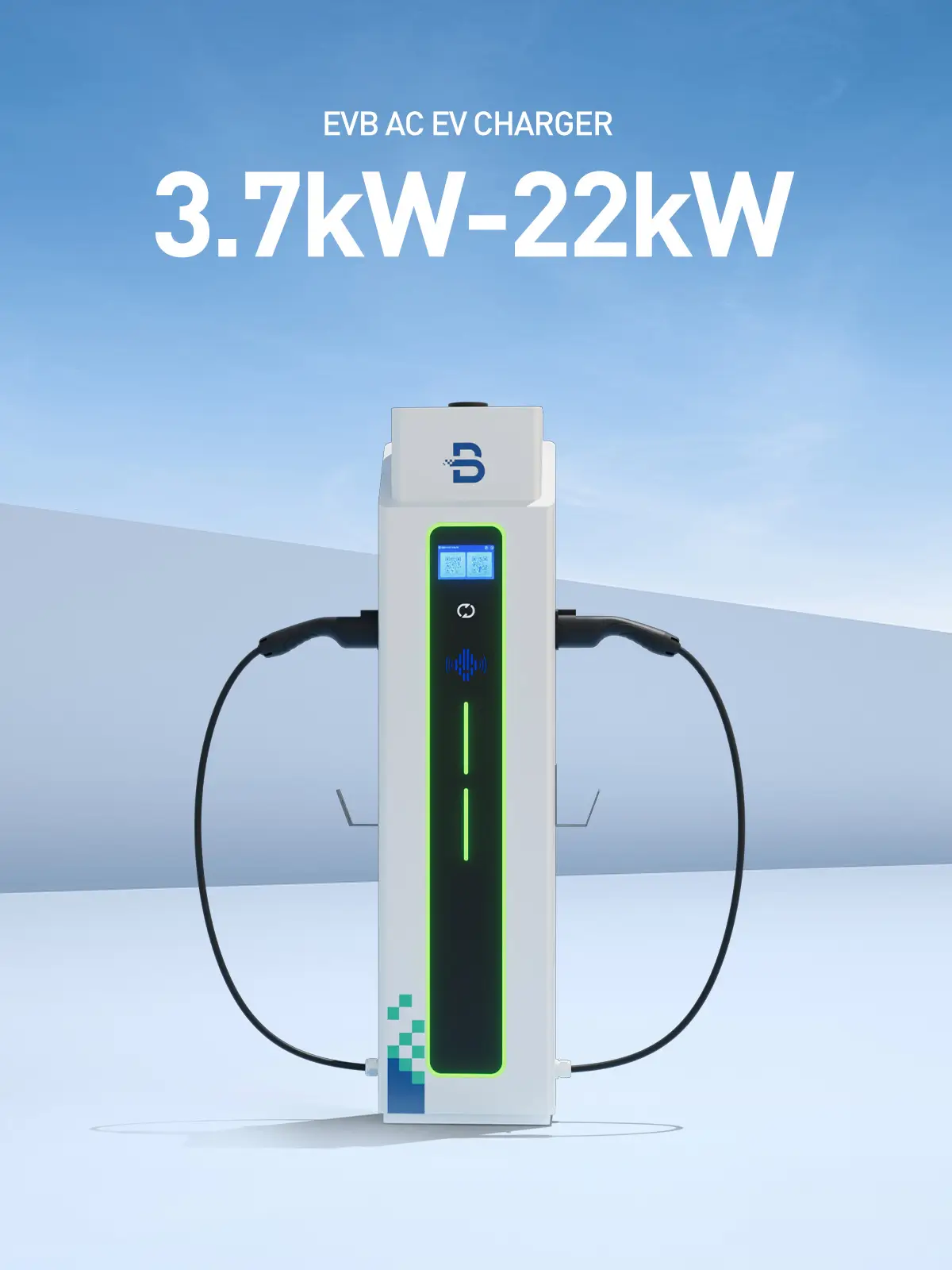
The EVB AC charging range lists a 22 kW Type 2 family alongside wall-mounted, dual-socket and floor-mounted products with a payment terminal. Those are different procurement starting points. The category listing should lead to a specific proposed model and configuration, rather than one assumption applied to every product.
Ask the supplier to complete the vehicle-and-supply record against the actual offer. If a suggested version leaves one vehicle below the intended service level, the answer may be a different configuration, a different operating expectation or acceptance of that vehicle’s own limit. More equipment power cannot remove every restriction.
Keep future vehicles separate from current needs
A buyer may reasonably choose capacity intended for later vehicle purchases. State that purpose explicitly. The current fleet’s performance and the expected benefit for a future vehicle are two different parts of the business case.
For example, an organisation expecting a model with greater AC acceptance can retain that as a future scenario. It should also record what remains uncertain: the purchase decision, vehicle specification, available supply or installation work. “Three-phase ready” is too vague to describe all of those dependencies.
Confirm the comparison in the installed configuration
Before accepting the proposed service, have the project team observe representative vehicles on the actual equipment and settings. Record the vehicle, cable, chargepoint identity and relevant operating conditions. Compare the observed result with the documented expectation, rather than with the largest number printed on the unit.
If there is a difference, the record gives the supplier somewhere concrete to start. If the result matches, it becomes a useful reference for explaining why two vehicles behave differently. A clear purchasing record makes both conversations easier without promising that every visitor will receive the same charging power.